


Standard plate for coating thickness gauge
Reliable coating thickness readings depend on more than the gauge itself. In daily inspection work, calibration accessories such as zero plates, certified foils, shim sets, and test blocks help users verify instrument condition, check measurement repeatability, and improve confidence before measuring painted or coated surfaces.
Standard plate for coating thickness gauge products are used as reference tools in coating inspection workflows. They are especially important when operators need to confirm zero setting, simulate known coating thickness values, or check whether a gauge is performing correctly on ferrous and non-ferrous substrates.
Why reference plates and shim sets matter
A coating thickness gauge can only deliver dependable results when it is checked against known references. In practice, inspectors often need to verify the instrument before starting a job, after changing substrate type, or when traceability is required for quality documentation. That is where zero test plates, certified foils, and calibration blocks become essential.
These accessories do not replace the gauge; they support it. A zero plate provides a known uncoated reference surface, while precision foils or shims introduce controlled thickness values that help confirm measurement response across a working range. For users comparing accessories with complete instruments, the broader coating thickness meter category can help place these items in the full inspection setup.
Typical products in this category
This category includes several common reference tools used with coating thickness instruments. Examples from ELCOMETER include the T9999529 Zero Test Plates, the T9994055 Zero Test Plates for non-ferrous applications, and multiple certified foil or shim sets such as the T99022255-2C, T99022255-5C, and Scale M3 Precision Foil Set.
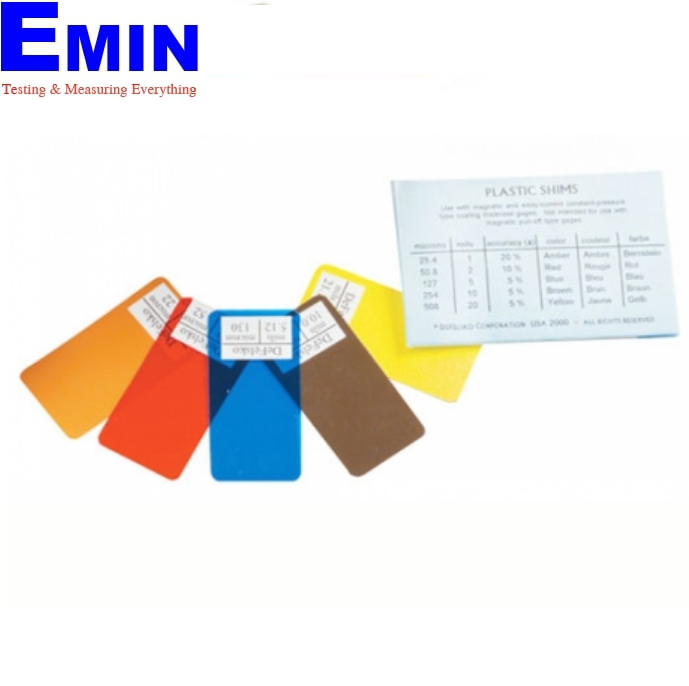
There are also accessories intended for roughness or replica tape verification workflows, such as the T99022255-1C, T99022255-2, T99022255-3, and T99022255-6 certified shim sets, along with the TW33119218 calibration test block. Another useful example is the DEFELSKO STDCSS Certified Plastic Shim Set, which illustrates the role of certified shims in routine gauge checks.
Zero plates, precision foils, and calibration blocks
Zero plates are typically used to set or confirm the baseline reading of a coating thickness gauge. They are especially relevant when measuring on different base materials, because the substrate influences how many gauges interpret thickness. Choosing the correct zero plate type, including versions intended for non-ferrous use, helps reduce setup errors before actual coating inspection begins.
Precision foils and shim sets are used to simulate a known coating layer. They are available in multiple thickness values, from thin micrometer-level references to thicker millimeter-range options, depending on the measuring range of the instrument and the application. Calibration test blocks serve a similar verification purpose in certain testing workflows, giving the operator a controlled reference when checking instrument response.
How to choose the right reference accessory
The first step is to match the accessory to the measuring principle and working range of the gauge. A user checking thin paint or powder coating layers may need a different foil range than someone inspecting thicker protective coatings or rougher industrial surfaces. It is also important to consider whether the gauge is used on ferrous steel, non-ferrous metals, or both.
Another key factor is whether the application requires certified reference values. In quality-controlled environments, certified precision foils or certified plastic shim sets may be preferable because they support more structured verification procedures. If the inspection process includes several coating properties, users may also work alongside related tools such as an adhesion tester or other paint testing equipment as part of a broader QA workflow.
Common use cases in coating inspection
These reference accessories are widely used in incoming inspection, production quality checks, maintenance shutdowns, corrosion protection projects, and laboratory validation. Before measuring a coated component, an inspector can use a zero plate to confirm the starting point, then place one or more shims on the substrate to verify whether the gauge reads close to the known value.
This process is useful for paint shops, surface treatment lines, marine and offshore maintenance, fabrication workshops, and protective coating contractors. It is also relevant when measurements need to be compared with acceptance criteria, customer specifications, or internal quality procedures. In applications where coating integrity is assessed more broadly, users may also review tools such as a holiday detector for complementary inspection tasks.
Certified sets and range coverage
One practical difference between products in this category is the available thickness range. Some foil sets focus on lower values suitable for thinner coatings, while others extend into higher micrometer and millimeter ranges for heavier systems. For example, the listed ELCOMETER sets cover a variety of values, allowing users to select reference points that better fit their target measurement window.
Accuracy and certification details also matter. Certain precision foil sets are described as certified, and some include stated tolerance information. For technical buyers, this can be important when selecting accessories for documented verification routines rather than simple day-to-day spot checks.
Good practice for using standard plates with coating gauges
To get meaningful results, the reference accessory should be clean, undamaged, and used according to the gauge manufacturer’s procedure. Dust, scratches, bending, or poor contact between foil and substrate can affect the reading and lead to unnecessary doubt about the instrument. Consistent handling is just as important as the accessory itself.
It is also good practice to verify the gauge at more than one point within the expected measurement range, not only at zero. This gives a better picture of performance under real operating conditions. For teams working with specialized substrates beyond metal, the separate category for coating thickness gage for non-metal may also be relevant when planning the overall measurement approach.
Supporting consistent measurement decisions
Choosing the right standard plate or shim set helps make coating thickness measurement more repeatable, more transparent, and easier to document. Whether the goal is a quick pre-job check or a more formal verification routine, these accessories play a practical role in reducing uncertainty around the gauge reading.
Within this category, buyers can compare zero plates, certified precision foils, shim sets, and calibration blocks based on substrate type, thickness range, and verification needs. A well-matched reference accessory supports more confident inspection work and helps keep coating evaluation aligned with real operating requirements.
-
-
-
-
-
-
-
-
-
-
-
-
-
-
-
-
-
-
-
-
-
-
-
-